Opening article
What FDE means at OpenAI
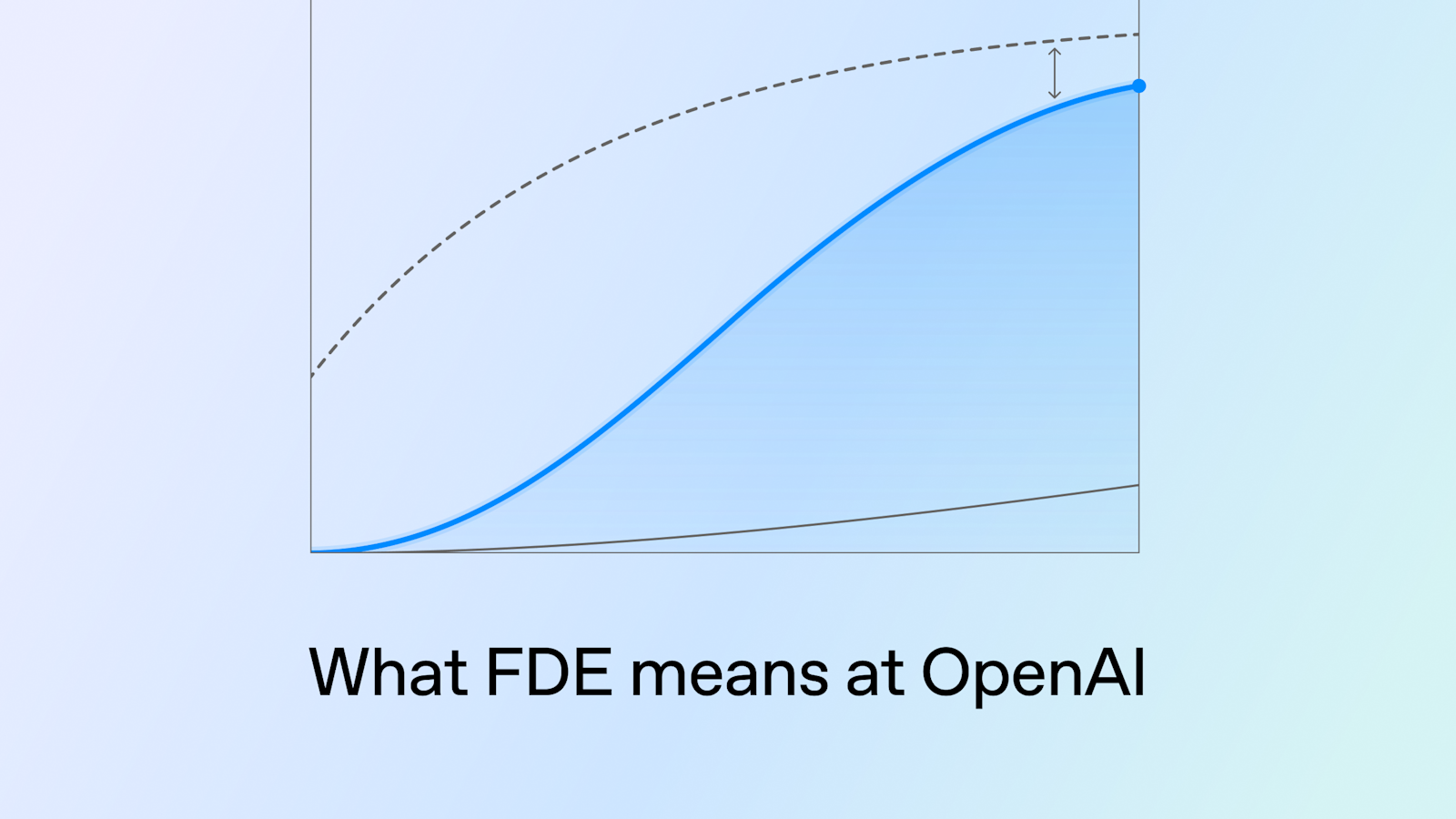
When Codex came out, someone on the team asked me, “What do we do when Codex can just one-shot the use cases we spent the last few months building?” Where our models can do the job today, we work with Product and our customer to make the solution repeatable and, where they fall short, we work with customers and Research to define the gap and make improvements. Our goal is for each engagement to leave the next customer with a better starting point—if we raise the floor to the point our customers don’t need FDEs to solve this class of problem the next time, we have done our job well. Our job is to solve the customer’s problem to a standard we can stand behind in production.
Benchmark Metric
70%
Reported Accuracy / GainCategory
Products
Industry DomainThe Core Development
When Codex came out, someone on the team asked me, “What do we do when Codex can just one-shot the use cases we spent the last few months building?”
That question gets to the heart of what FDE means at OpenAI. We work alongside customers to understand their hardest problems and build solutions they can depend on. What we learn helps shape our products and gives Research concrete problems to solve.
That is progress. If we make ourselves obsolete every couple of months, our FDE team is doing its job.
Real-World Use Cases & Applications
This is the kind of challenge OpenAI FDEs work to solve: helping organizations move from AI capabilities to systems that deliver practical value in complex, real-world environments.
In mid-2025, we had around 15 FDEs working with a large semiconductor customer on 10+ use cases. The ambition was to make their verification process AI-native, covering:
Some FDEs had joined OpenAI just days earlier and had never worked in semiconductors. They embedded with the customer’s verification team, studied chip design in their spare time, and built evals with the engineers to test whether the AI could generate useful tests and correctly diagnose chip failures. Alongside that learning, we built custom harnesses for the individual use cases. Over the first 3-6 months, all of them reached production and early user adoption. The payoff was seeing the metrics:
Deployment & Availability
John Deere deployed OpenAI’s APIs to help make that support personalized and scalable.
Strategic Perspective & Ecosystem Impact
I founded the team in early 2025 to close what we call “the deployment gap”: the distance between what models appear capable of and what people can reliably use to do their work.
Model capabilities have moved faster than the systems and processes needed to put them to use. Sometimes the missing piece is a product. Sometimes a model performs well on a benchmark but cannot do the job with real-life variables and constraints.
We focus on customers’ hardest problems. Where our models can do the job today, we work with Product and our customer to make the solution repeatable and, where they fall short, we work with customers and Research to define the gap and make improvements. Our goal is for each engagement to leave the next customer with a better starting point—if we raise the floor to the point our customers don’t need FDEs to solve this class of problem the next time, we have done our job well.
Why it matters
What forward deployed engineering means at OpenAI Reported by OpenAI on October 22, 2026.
Topic dossiers OpenAI