Opening article
The first AI-planned drive on Mars
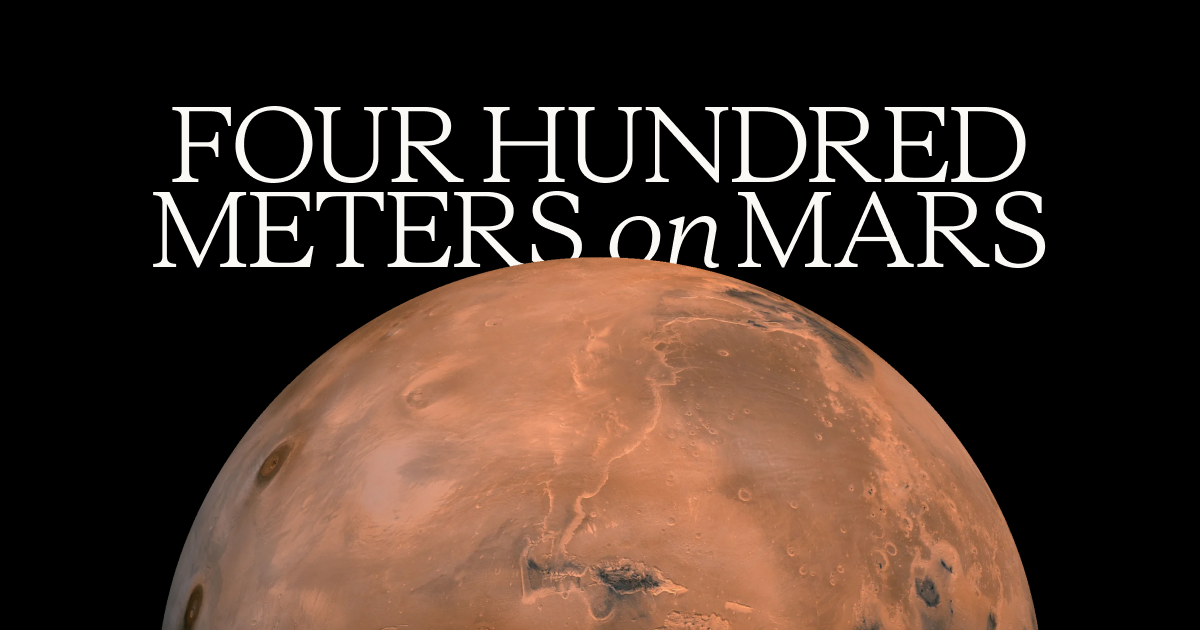
The first AI-planned drive on Mars — announced via Anthropic News on January 24, 2026. But on December 8 and 10, 2025, the commands that were sent to NASA’s Perseverance Rover looked like something from the future. Engineers at NASA’s Jet Propulsion Laboratory (JPL) used Claude to plot out the route for Perseverance to navigate an approximately four-hundred-meter path through a field of rocks on the Martian surface. The JPL engineers gathered together the data and experience they’d gained from years of driving the rover, and provided it to Claude Code .
Category
Products
Industry DomainThe Core Development
Exploring new planets means that you’re always operating in the past. It takes about twenty minutes for a signal to reach a Mars rover from Earth; by the time a new instruction arrives, the rover will already have acted on the previous one.
But on December 8 and 10, 2025, the commands that were sent to NASA’s Perseverance Rover looked like something from the future. That’s because, for the first time ever, they’d been written by an AI.
Specifically, they were written by Anthropic’s AI model, Claude. Engineers at NASA’s Jet Propulsion Laboratory (JPL) used Claude to plot out the route for Perseverance to navigate an approximately four-hundred-meter path through a field of rocks on the Martian surface.
Deployment & Availability
Just as Claude can apply its intelligence to the range of rather more sublunary tasks we carry out on Earth, developing a general AI assistant that’s versatile and reliable enough to help with everything from mapping lunar geology to monitoring the astronauts’ life-support systems will be a force multiplier for NASA missions to the Moon and Mars.
Strategic Perspective & Ecosystem Impact
Because of the delay in the signal to the rover, operators can’t micromanage where it drives. They plan a route, send it, and only later see the results. Until now, human experts have always been the ones to do that planning. This time, Claude lent a hand.
Four hundred meters isn’t far: it’s one lap of a running track. But it’s a start. Claude—the same AI model that people use to draft emails, build software apps, and analyze their company’s finances—is now helping humanity explore other worlds.
The Perseverance Rover—a car-sized robot bristling with cameras and scientific equipment—has been active on Mars since it landed in February 2021. Its mission is to characterize the planet’s geology and past climate, collecting samples of Martian rock and regolith (broken rocks and dust) and paving the way for human exploration of the Red Planet. Another of its key objectives is astrobiological in nature: its landing site, the forty-five-kilometer-wide Jezero crater, was chosen because of the evidence that once, billions of years ago, it contained water—water that might have supported microbial life. So far, the rover has discovered tantalizing hints of what might be ancient biology on Mars.
Why it matters
The first AI-planned drive on Mars — announced via Anthropic News on January 24, 2026 Reported by Anthropic News on January 24, 2026.
Topic dossiers Anthropic & Claude