Opening article
How we built a realtime system for responsive voice AI in six months
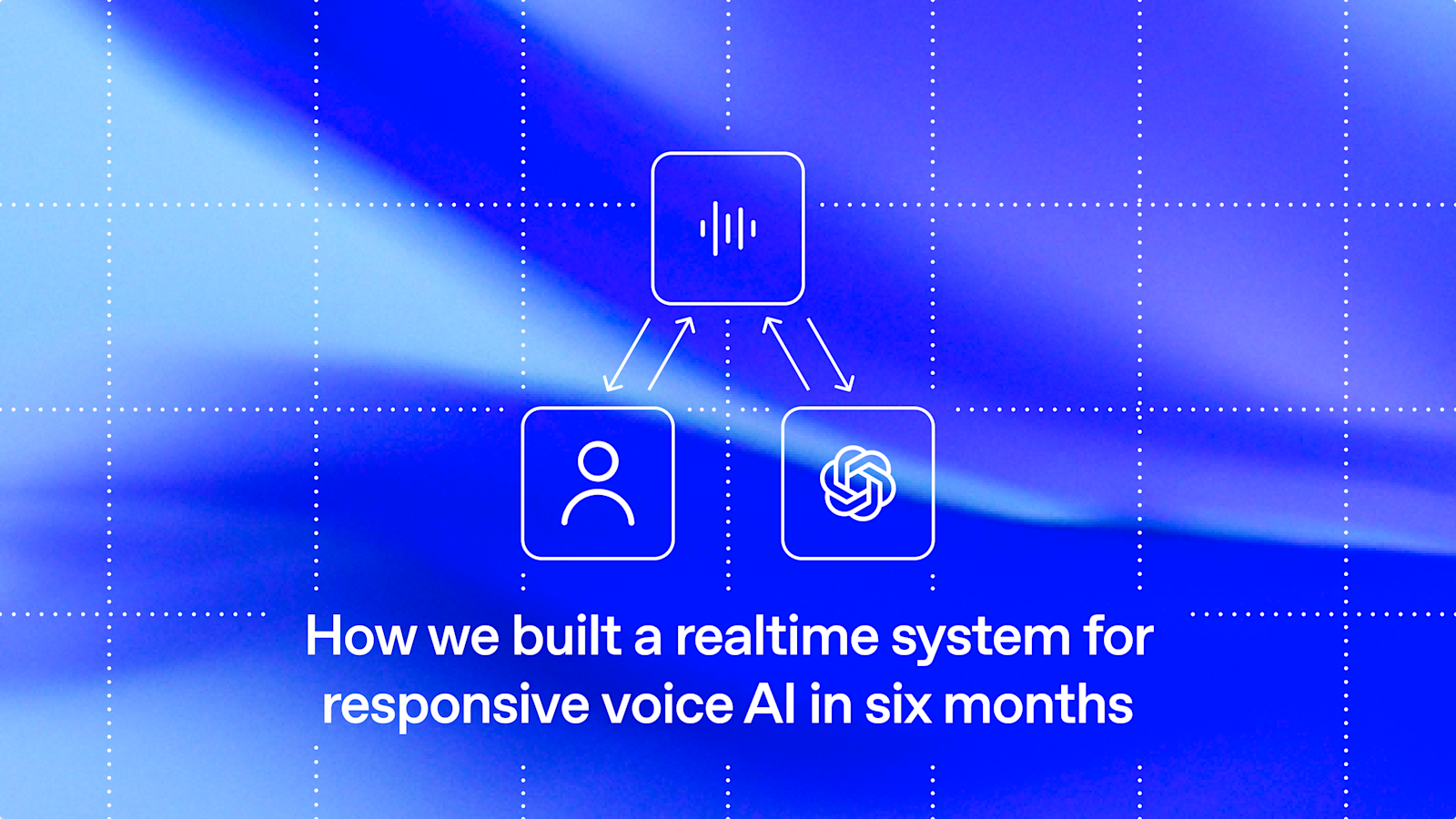
GPT-Live enables continuous voice interaction with AI, using a turnless speech model and low-latency architecture for faster, more natural conversations. GPT‑Live , our third-generation voice system, removes the turn detector from the audio path. Unlike typical request-response inference, our system streams incoming audio into the voice model and outbound speech back to the user, while handling delegation on a separate asynchronous path. GPT‑Live puts the voice model in control of the conversation: audio flows in and out of the model, while deeper reasoning and tool use happen asynchronously.
Category
Products
Industry DomainThe Core Development
For voice AI, knowing when to speak is harder than it sounds. Human speakers effortlessly hand off to each other in a fraction of a second, but previous voice AI systems couldn’t keep up with this rhythm. Their turn-based architecture relied on tiny models known as turn detectors, which faced an unenviable task: guess too soon, and the user gets cut off; guess too late, and the response feels sluggish. Only after the detector made its decision could the much larger LLM get to work.
GPT‑Live , our third-generation voice system, removes the turn detector from the audio path. Its voice model is full-duplex, which means it can listen and speak at the same time. That eliminates the need for a separate detector and makes conversation feel more immediate and natural. When deeper reasoning or tool use is needed, GPT‑Live can also consult our frontier models, such as GPT‑5.5, without interrupting the flow of the conversation. Together, these capabilities give GPT‑Live an unprecedented combination of conversational responsiveness and intelligence.
Delivering this experience at scale required a new system architecture optimized for low latency. Unlike typical request-response inference, our system streams incoming audio into the voice model and outbound speech back to the user, while handling delegation on a separate asynchronous path. Over the last six months, we reworked model inference, context management, and media transport to keep speech flowing smoothly from end to end.
How It Works & Technical Architecture
The architecture also creates a clean boundary between the core voice path and application logic. This makes it easy to customize application behavior without affecting responsiveness. This foundation powers a growing range of capabilities in ChatGPT Voice, including the newly launched ability to control your computer and coordinate your agents in the ChatGPT desktop app.
GPT‑Live’s ability to invoke existing frontier models gives it a lot of power, effectively decoupling “talking” from deeper “thinking”. But making this two-model architecture feel like one system required solving two related engineering problems.
Deployment & Availability
Instead, we treat compaction as another managed transition. While the original model instance keeps chatting, the system compacts the context and prepares a replacement model instance with the new context. Once that instance is ready, we can switch over without any media interruption. This allows the system to support long-running calls, compacting whenever necessary.
Strategic Perspective & Ecosystem Impact
In this post, we’ll explain why earlier turn-based systems couldn’t meet our needs and how we engineered the new system for responsiveness at every layer. We’ll cover stateful inference, dynamic context management, asynchronous delegation, and protocol-level optimization, all working together to make GPT‑Live feel truly live .
Earlier voice architectures inherited the turn-based nature of text LLMs, but with each turn represented as a discrete audio blob rather than text. In cascaded systems, speech-to-text, the LLM, and text-to-speech each ran in series. This sequencing added latency and ignored cues such as tone and pacing.
Speech-to-speech models improved on this approach by processing audio directly. Training the model to natively understand and generate speech allowed it to preserve details lost in transcription and respond more quickly. But the system still relied on the turn detector to decide when inference could begin. The model handled more of the interaction, but the interaction remained turn-based.
Why it matters
GPT-Live enables continuous voice interaction with AI, using a turnless speech model and low-latency architecture for faster, more natural conversations Reported by OpenAI on August 3, 2026.
Topic dossiers OpenAI